
 Trustpilot










POPULAR COURSES


ALL COURSES
- L2 Award for Cash And Valuables In Transit (CViT)
- Security Drone Pilot
- Security Screening BS7858
- SIA CCTV Operator Training
- SIA Close Protection Training
- SIA Door Supervisor Training
- SIA Security Guard Training
- SIA Top-Up Refresher Training for Close Protection
- SIA Top-Up Refresher Training for Door Supervisor
- SIA Top-Up Refresher Training for Security Guard
- Use of Mechanical Restraints (Handcuffs) - L3 Award
POPULAR LICENCES
ALL LICENCES
- Cash and Valuables in Transit (CVIT) Licence
- CCTV Licence
- Close Protection Licence
- How to get an SIA Licence
- Key Holding Licence
- Security Guard Licence
- SIA Door Supervisor Licence
- SIA Licence Bangladesh Passport
- SIA Licence Ghanaian Passport
- SIA Licence Indian Passport
- SIA Licence Irish Passport
- SIA Licence Nigerian Passport
- SIA Licence on Pakistani Passport
- SIA Licence Poland Passport
- SIA Licence Romanian Passport
- SIA Licence South African Passport
POPULAR COURSES
ALL LOCATIONS
- Andover
- Ashford
- Aylesbury
- Barking
- Barnsley
- Basingstoke
- Belfast
- Birmingham
- Birmingham-Central
- Birmingham-Edgbaston
- Blackburn
- Bournemouth
- Bradford
- Brentwood
- Brighton
- Brighton-City Centre
- Bristol
- Burnley
- Bushey
- Cambridge
- Cardiff
- Chatham
- Chelmsford
- Cheltenham
- Chester
- Colchester
- Coventry
- Crawley
- Crawley-Central
- Derby
- Dundee
- Durham
- Edinburgh
- Exeter
- Exmouth
- Glasgow
- Gloucester
- Hemel Hempstead
- Hereford North
- Hull
- Ipswich
- Leeds
- Leicester
- Leicester-City Centre
- Liverpool
- London Ilford-Central
- London-Acton
- London-Aldgate
- London-Barnet
- London-Beckenham
- London-Bermondsey
- London-Bromley
- London-Central
- London-Chigwell
- London-Clapham
- London-Croydon
- London-Ealing
- London-East Ham
- London-Enfield
- London-ExCeL
- London-Finsbury Park
- London-Greenford
- London-Hanwell
- London-Hayes-and-Southall
- London-Holborn
- London-Ilford
- London-Kingston Upon Thames
- London-Mile-End
- London-Park Royal
- London-Putney
- London-Ruislip
- London-Russell Square
- London-South Croydon
- London-Tottenham Court Rd
- London-Uxbridge
- London-Wembley
- London-Westminster
- London-Wimbledon
- London-Wood Green
- London-Woolwich
- Luton
- Manchester
- Manchester-Central
- Manchester-Piccadilly
- Middlesbrough
- Milton Keynes
- Milton Keynes-Central
- Newcastle Upon Tyne
- Newcastle upon Tyne- Central
- Newport
- Northampton
- Norwich
- Nottingham
- Nottingham-City Centre
- Nottingham-Derby
- oban
- Omagh
- Peterborough
- Plymouth
- Portsmouth
- Preston
- Reading
- Salisbury
- Sheffield
- Slough
- Southampton
- Stoke-on-Trent
- Swansea
- Telford
- Wakefield
- Walsall
- Watford
- Wiltshire
- Winchester
- Wolverhampton
- Worcester
- Andover
- Barking
- Barnsley
- Belfast
- Birmingham
- Bolton-Breightmet Street
- Bournemouth
- Bradford
- Brentwood
- Brighton
- Brighton-City Centre
- Bristol
- Cardiff
- Chelmsford
- Chester
- Coventry
- Derby
- Edinburgh
- Glasgow
- Hereford North
- Leeds
- Leicester
- Liverpool
- London Ilford-Central
- London-Central
- London-Chigwell
- London-Croydon
- London-Finsbury Park
- London-Greenford
- London-Holborn
- London-Holborn-Central
- London-Ilford
- London-Kensington
- London-Kingston Upon Thames
- London-Ruislip
- London-Russell Square
- London-Tottenham Court Rd
- London-Wembley
- London-Westminster
- London-Wood Green
- London-Woolwich
- Luton
- Manchester
- Manchester-Central
- Milton Keynes
- Newcastle Upon Tyne
- Newport
- Norwich
- Nottingham
- Plymouth
- Portsmouth
- Preston
- Salisbury
- Sheffield
- Slough
- Southampton
- Stoke-on-Trent
- Swindon
- Telford
- Wakefield
- Winchester
- Worcester
- Zoom
- Birmingham
- Birmingham-Central Tyseley
- Birmingham-Edgbaston
- Bristol
- Cardiff
- Chester
- Coventry
- Hull
- Leeds
- Leicester
- Liverpool
- London-Aldgate
- London-Central
- London-East Ham
- London-ExCeL
- London-Holborn
- London-Kingston Upon Thames
- London-Mile-End
- London-Russell Square
- London-Tottenham Court Rd
- London-Westminster
- Manchester
- Newcastle Upon Tyne
- Newport
- Nottingham-City Centre
- oban
- Portsmouth
- Reading
- Sheffield-City Centre
- Slough
- Slough-Windsor
- Stoke-on-Trent
- Andover
- Ashford
- Aylesbury
- Barking
- Barnsley
- Basingstoke
- Belfast
- Birmingham
- Birmingham-Central
- Birmingham-Central Tyseley
- Bolton
- Bolton-Breightmet Street
- Bournemouth
- Bradford
- Brentwood
- Brighton
- Brighton-City Centre
- Bristol
- Bushey
- Cambridge
- Cardiff
- Chatham
- Chelmsford
- Cheltenham
- Chester
- Colchester
- Coventry
- Crawley
- Derby
- Edinburgh
- Exeter
- Exmouth
- Glasgow
- Gloucester
- Guildford
- Hemel Hempstead
- Hereford North
- Hull
- Ipswich
- Leeds
- Leeds Central
- Leicester-City Centre
- Liverpool
- London Ilford-Central
- London-Acton
- London-Aldgate
- London-Barnet
- London-Beckenham
- London-Bermondsey
- London-Bromley
- London-Central
- London-Clapham
- London-Croydon
- London-Dagenham
- London-East Ham
- London-Enfield
- London-ExCeL
- London-Finsbury Park
- London-Greenford
- London-Hayes-and-Southall
- London-Holborn
- London-Kennington
- London-Kensington
- London-Kensington Central
- London-Kingston Upon Thames
- London-Mile-End
- London-Park Royal
- London-Putney
- London-Romford
- London-Ruislip
- London-Russell Square
- London-Stratford
- London-Tottenham Court Rd
- London-Uxbridge
- London-Wembley
- London-Wimbledon
- London-Wood Green
- London-Woolwich
- Luton
- Manchester
- Manchester-Central
- Manchester-Piccadilly
- Middlesbrough
- Milton Keynes
- Milton Keynes-Central
- Newcastle Upon Tyne
- Newcastle upon Tyne- Central
- Newport
- Northampton
- Norwich
- Nottingham
- oban
- Oldham
- Peterborough
- Plymouth
- Portsmouth
- Preston
- Reading
- Salisbury
- Sheffield
- Slough
- Southampton
- Southend On Sea
- Stoke-on-Trent
- Swindon
- Telford
- Wakefield
- Walsall
- Watford
- Wiltshire
- Winchester
- Woking
- Wolverhampton
- Worcester
- Andover
- Birmingham
- Bolton-Breightmet Street
- Bournemouth
- Bristol
- Cardiff
- Chester
- Coventry
- Derby
- Glasgow
- Hereford North
- Leeds
- Leicester
- Liverpool
- London-Aldgate
- London-Brixton
- London-Central
- London-East Ham
- London-ExCeL
- London-Finsbury Park
- London-Holborn
- London-Kensington
- London-Kensington Central
- London-Kingston Upon Thames
- London-Mile-End
- London-Russell Square
- London-Tottenham Court Rd
- London-Wood Green
- Manchester
- Newcastle Upon Tyne
- Newport
- Nottingham
- oban
- Portsmouth
- Salisbury
- Sheffield
- Slough
- Southampton
- Telford
- Winchester
- Worcester
ALL CAREERS
- ARC Operator
- Area Relief Security Officer
- Close Protection Officer
- Control Room Operator
- Corporate Security Officer
- Distribution Security Officer
- Front of House Officer
- Key Response Officer
- Loading Bay Supervisor
- Mobile Security Supervisor
- Night Shift Security Officer
- Nightclub Doorman
- Retail Security Officer
- Security Command Centre Manager
- Security Concierge
- Security Manager
- Security Patrol Officer
- Static Security Officer
- Venue Security Officer

Britain's Festival Safety Audit 2026: What Really Changed Between 2024 And 2025

by Get Licensed | May 15, 2026 | Reading Time: 15 mins
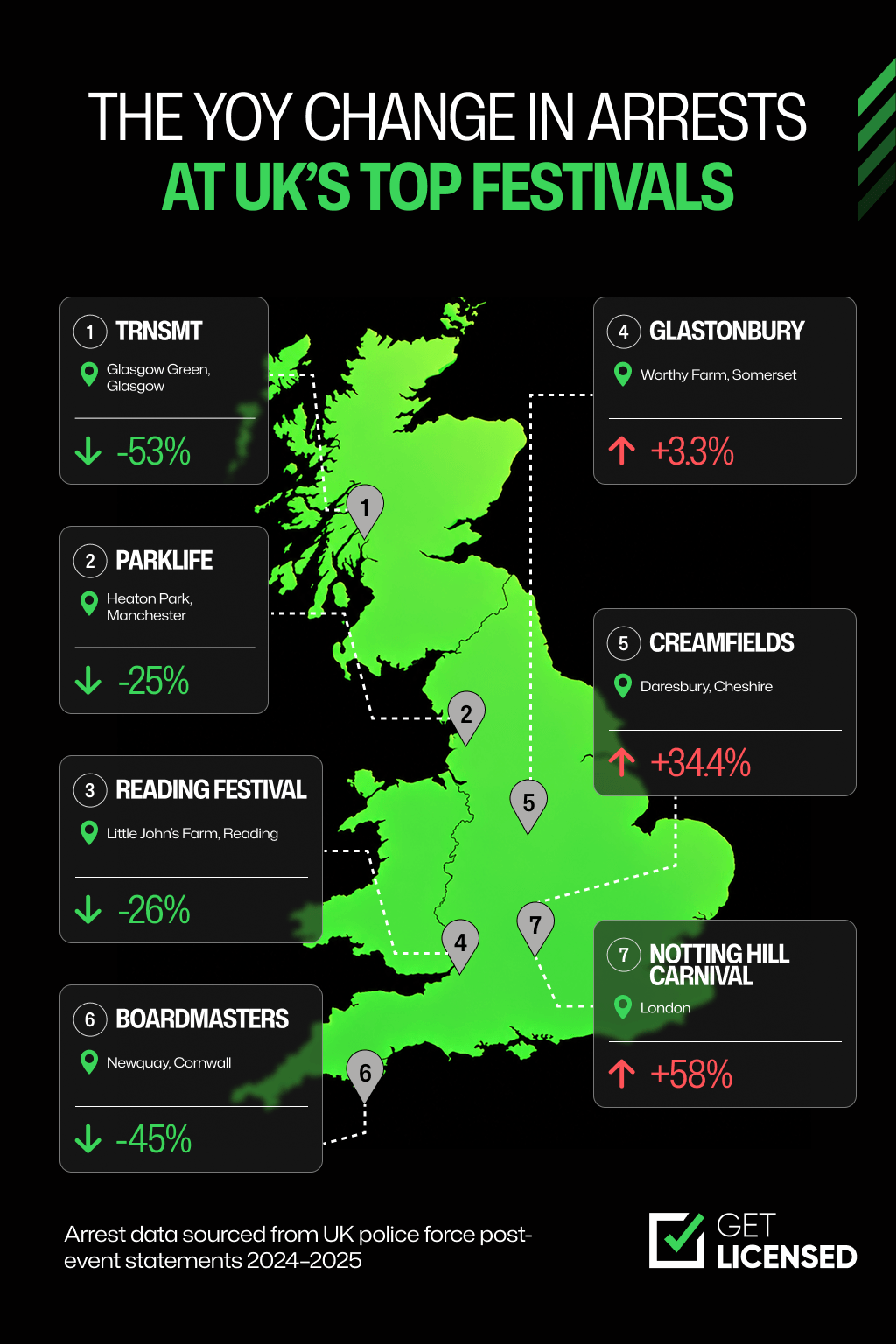
At Parklife, arrests fell 25% between 2024 and 2025. At TRNSMT, they fell 53%. At Boardmasters, they dropped by 45% in a single year. At Reading Festival, they fell 26%. Yet at Creamfields, arrests rose 34.4%, and at Glastonbury, they rose 3.3%. At Notting Hill Carnival, arrests climbed to 528, but stabbings fell from eight to four, and none were life-threatening.
Something shifted at Britain's major music festivals in 2025, but not uniformly. The headline numbers most newspapers ran tell a fragmented story. Pulled together, the post-event data from seven UK police forces tells a more complex one: the festivals investing in pre-event gate screening, welfare infrastructure and on-site drug checking are producing materially better outcomes. The ones that aren't, or those operating at significantly larger scales, show different patterns. Understanding why matters for 2026.
This report covers the ticketed festivals where clean year-on-year data exists — Parklife, TRNSMT, Boardmasters, Reading Festival, Creamfields and Glastonbury — alongside the standalone story of Notting Hill Carnival, the UK's largest single event of the year.
With Glastonbury on a fallow year in 2026 and Wireless cancelled, the 2026 season will look materially different from 2025.
Key Findings
- Arrests fell at four major UK festivals in 2025 vs 2024: TRNSMT −53%, Boardmasters −45%, Parklife −25%, Reading Festival −26%.
- Arrests rose at two major festivals in 2025 vs 2024: Creamfields +34.4%, Glastonbury +3.3%.
- At Notting Hill Carnival, arrests rose 58% to 528, but stabbings halved from 8 to 4.
- No drug-related deaths have occurred at UK festivals where The Loop has operated drug-checking since 2016.
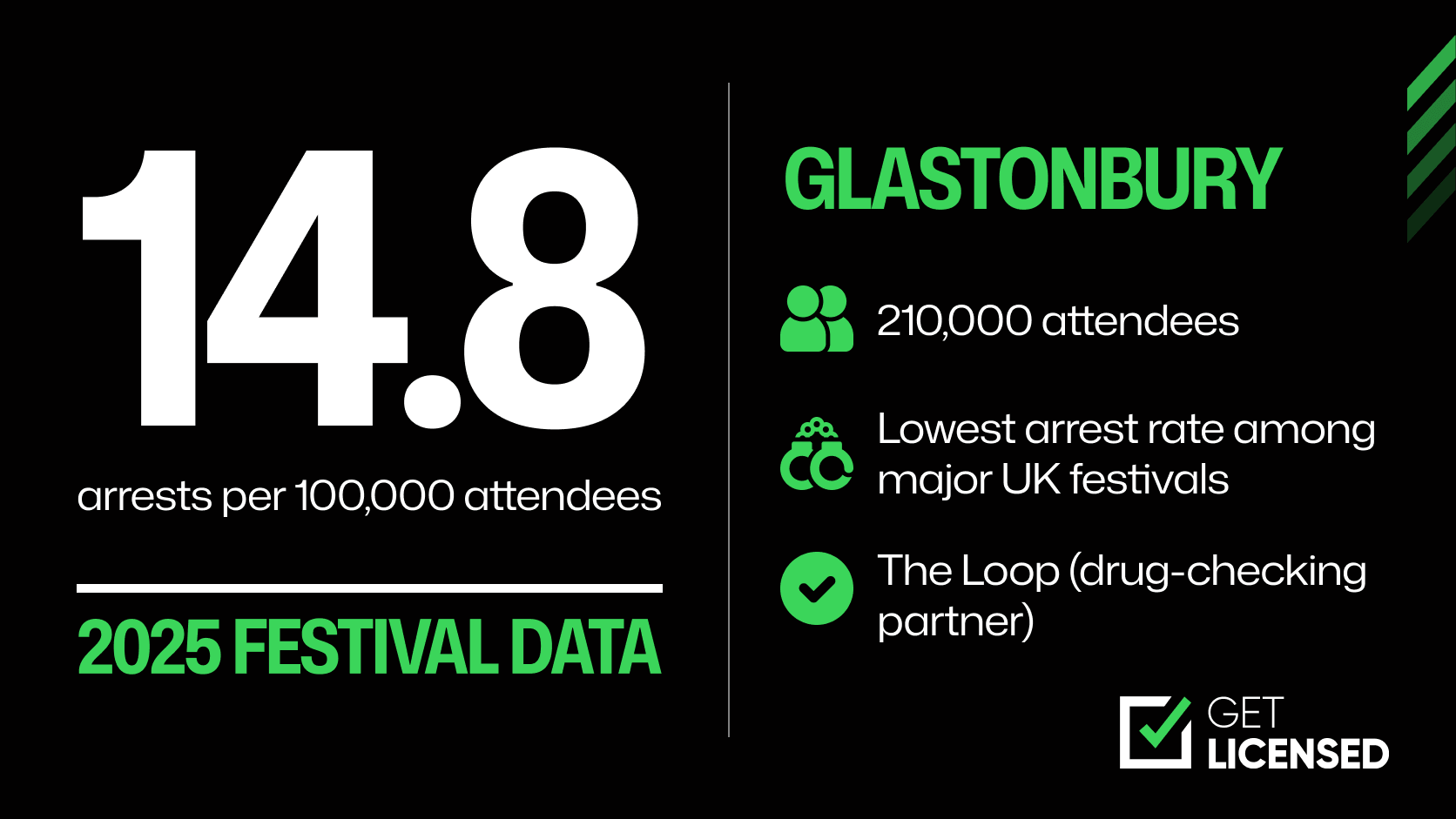
- Glastonbury 2025 had the lowest per-attendee crime rate in this report: 31 arrests and 145 crimes against a 210,000-capacity event.
- Glastonbury is not running in 2026 — Worthy Farm takes a fallow year, returning in 2027.
- Wireless Festival was cancelled for 2026 after its scheduled headliner's UK entry was denied.
The 2024–2025 Festival Ranking
| Festival | Location | 2024 Arrests | 2025 Arrests | YoY Change |
|---|---|---|---|---|
| Parklife | Heaton Park, Manchester | 52 | 39 | −25% |
| TRNSMT | Glasgow Green, Glasgow | 40 | 19 | −53% |
| Boardmasters | Newquay, Cornwall | 11 | 6 | −45% |
| Reading Festival | Little John's Farm, Reading | 39 | 29 | −26% |
| Glastonbury | Worthy Farm, Somerset | 30 | 31 | +3.3% |
| Creamfields | Daresbury, Cheshire | 32 | 43 | +34.4% |
| Notting Hill Carnival | London (free, 2M+) | 334 | 528 | +58% |
The 2025 data reveals a more nuanced picture than headline arrest numbers suggest. Four festivals — Parklife, TRNSMT, Boardmasters and Reading — recorded double-digit percentage falls in arrests. Two others — Creamfields and Glastonbury — saw modest increases, with Creamfields arrests rising 34.4% and Glastonbury rising 3.3%.
The divergence matters: the festivals posting the strongest improvements share operational characteristics (enhanced gate screening, established welfare infrastructure, drug-checking partnerships), whilst the two with rising figures operated without published drug-checking services. This pattern suggests that safety outcomes are not random, but reflect deliberate operational choices.
Festival Spotlights
Each festival's data at a glance, drawn from the responsible UK police force's own published 2024 and 2025 figures.
Parklife
Heaton Park, Manchester | ~80,000 capacity
Drug-checking partner: The Loop.
- 2024: 52 arrests
- 2025: 39 arrests
- YoY: −25%
Status: Running June 2026
TRNSMT
Glasgow Green, Glasgow | ~50,000 capacity per day
- 2024: 40 arrests
- 2025: 19 arrests
- YoY: −53%
Status: Running July 2026.
Boardmasters
Newquay, Cornwall | ~60,000 capacity
Loop participation history.
- 2024: 11 arrests
- 2025: 6 arrests
- YoY: −45%
Status: Running August 2026.
Reading Festival
Little John's Farm, Reading | ~90,000 capacity
- 2024: 39 arrests
- 2025: 29 arrests, 223 crimes
- YoY: −26%
Status: Running August 2026.
Creamfields
Daresbury, Cheshire | ~70,000 capacity
- 2024: 32 arrests, 125 crimes
- 2025: 43 arrests, 143 crimes
- YoY: +34.4%
Status: Running August 2026.
Glastonbury
Worthy Farm, Somerset | 210,000 capacity (largest ticketed festival in the UK)
- 2024: 30 arrests, 121 crimes
- 2025: 31 arrests, 145 crimes (27 violence, 22 drugs, 13 public order)
- YoY: +3.3% arrests
Status: Fallow year 2026 — returning 2027.
Notting Hill Carnival
London | 2 million+ attendees (free event)
- 2024: 334 arrests, 8 stabbings, 1 fatal
- 2025: 528 arrests, 4 stabbings (none life-threatening), 61 via live facial recognition
- YoY: +58% (stabbings = −50%)
Status: Running August 2026.
The Gate Is The New Front Door
The single most consistent pattern across the 2025 data is the shift in where enforcement now happens. Greater Manchester Police explicitly credited the 2024 arrest profile at Parklife to "proactive work between GMP and event security staff, and a thorough search regime in place on the entry gates across Heaton Park".
The 2025 follow-up (39 arrests against 52 the year before) reflects the same approach, held steady with better results. At Reading Festival, Thames Valley Police reported its 2025 reduction was driven by enhanced gate screening and coordination with security staff.
Most of the gate-level work itself is done by SIA-licensed door supervisors and security guards — the trained civilian workforce that sits between the turnstile and the festival. These professionals form the first line of defence, operating under rigorous SIA standards that mandate training in conflict management, search procedures, and threat assessment. Their presence at scale, often numbering in the hundreds at major festivals, creates the density of coverage that makes interception possible.
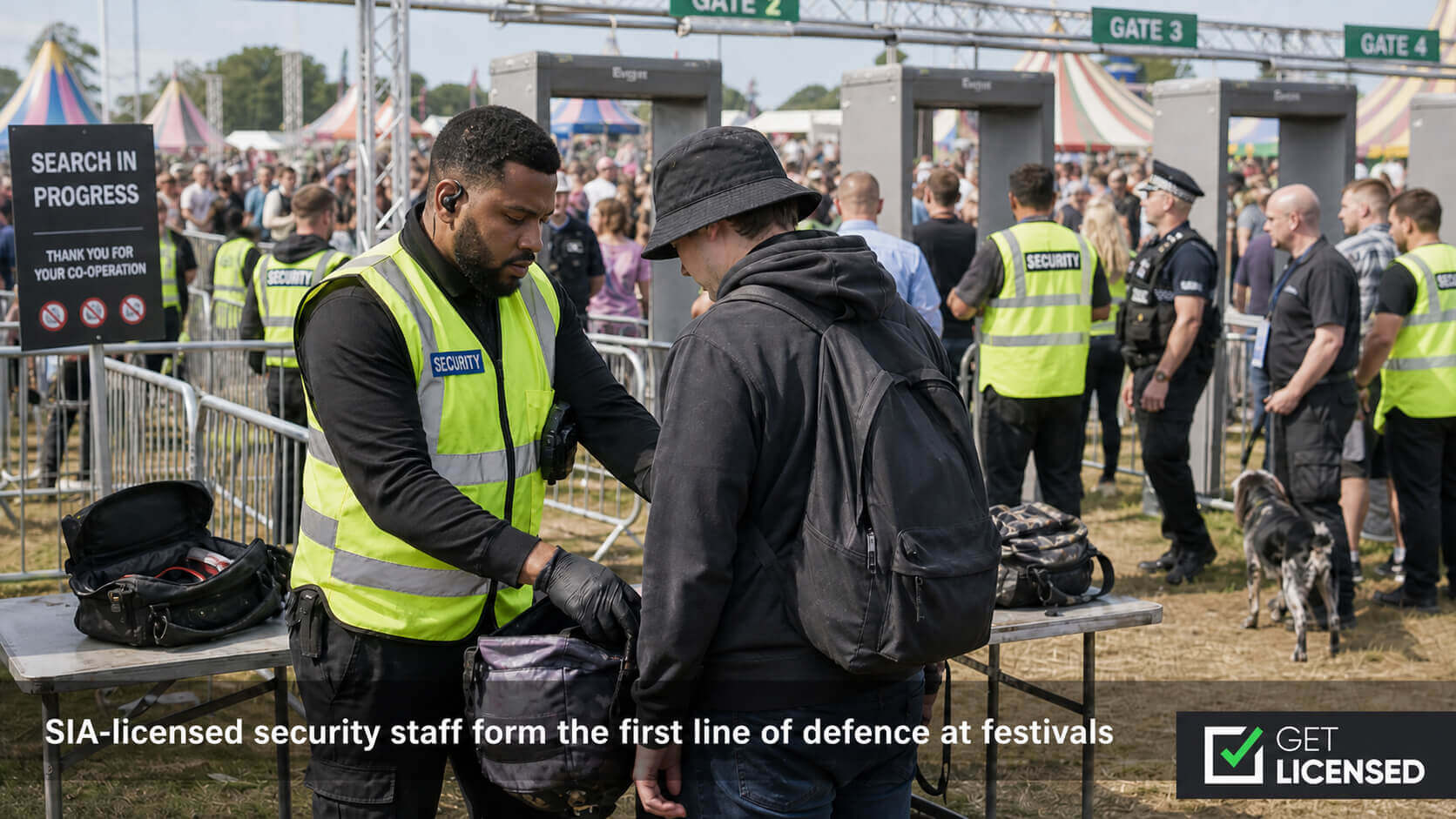
Their role has grown steadily: bag searches, body scans, behavioural screening, sniffer-dog handling alongside police teams, rapid escalation to on-site police when intercepted items cross a threshold. It is skilled work requiring both technical competence and judgment.
The operational improvements visible in the 2025 arrest data reflect both the quality and the density of that workforce on the gate. Festivals that invested in additional security staffing and enhanced training protocols in 2024 saw the sharpest reductions in 2025 — a direct correlation between professional gate-level security and measurable safety outcomes.
The Loop: The Single Most Important Harm-Reduction Lens
The UK's drug-checking charity, The Loop, has operated on-site testing at major British festivals since 2013. In 2024, it received the first-ever Home Office licences for on-site drug testing at UK festivals, formalising a service that had previously run on ad-hoc licensing arrangements.
The harm-reduction outcomes speak for themselves:
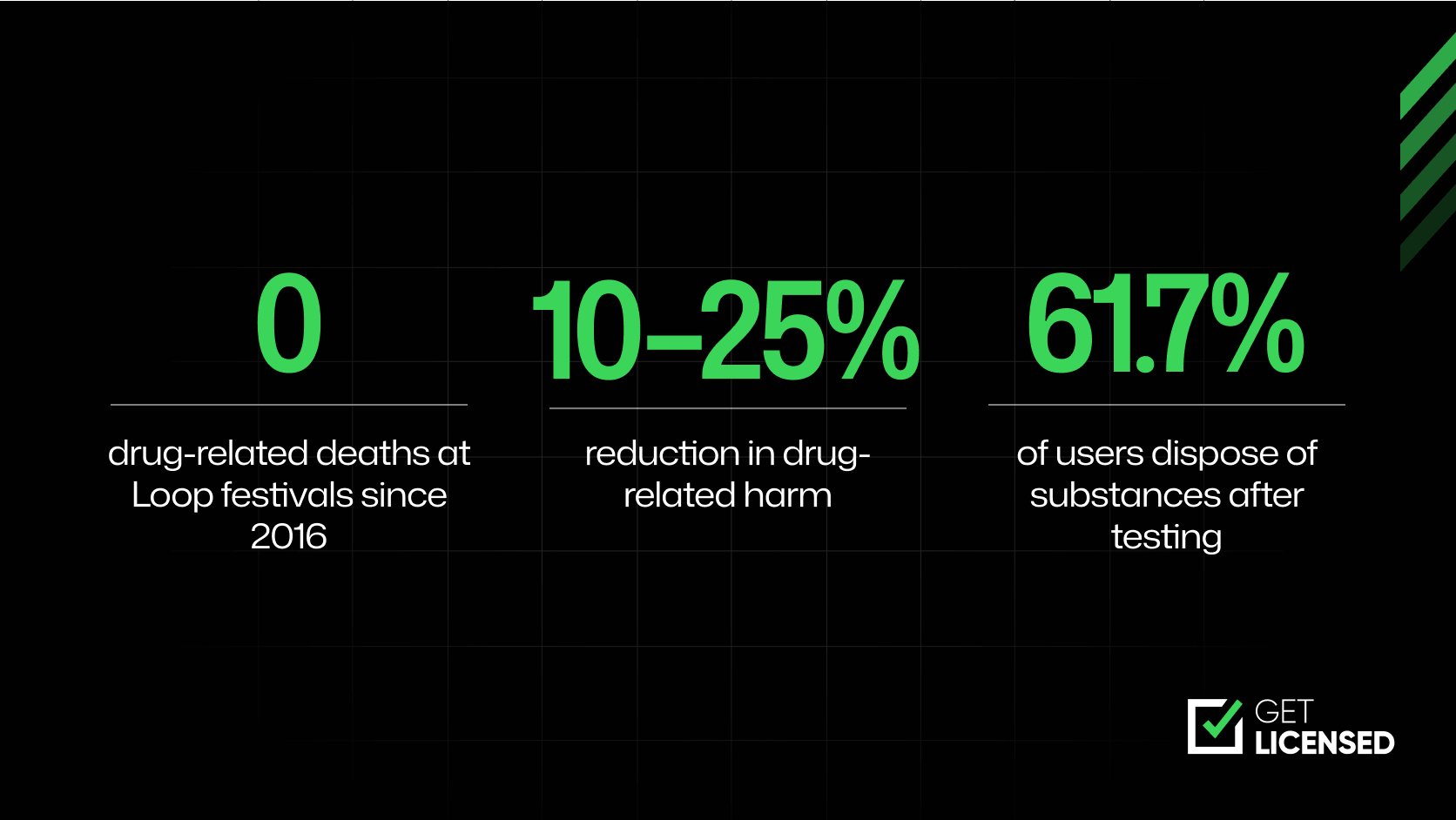
- No drug-related deaths at festivals where The Loop has operated since 2016.
- A 10 to 25% reduction in drug-related harm at festivals with on-site drug checking compared to those without.
- 61.7% of service users dispose of substances once testing shows they are not what they had been sold.
The contrast with festivals operating without The Loop is visible in the case record. Academic research cataloguing drug-related deaths at UK music festivals between 2017 and 2023 identified 18 confirmed deaths across events, including Reading, Creamfields and the Isle of Wight Festival, averaging approximately 2.6 deaths per year for confirmed cases.
In 2024, 22-year-old Benjamin Buckfield died at Boomtown after taking MDMA bought on site; a Hampshire Constabulary licensing review concluded dealers had been operating openly at the event.
The harm-reduction lens also extends well beyond the death toll. Published medical research from Glastonbury 2022 found that 164 of 2,828 medical visits at the festival — 5.48% — were intoxication-related, indicating the scale of welfare and medical infrastructure that even the best-resourced events have to maintain.
A 2025 academic survey of UK festival attendees confirmed that intoxication and welfare-driven medical demand remain the largest categorical pressures on festival medical teams, well above sport-injury or first-aid presentations.
Whether a festival publishes a drug-checking partnership is now one of the single most useful operational signals for attendees weighing up events. It also explains why the festivals with the strongest year-on-year improvements in 2025 were disproportionately those with established welfare and harm-reduction services.
Notting Hill Carnival: Why The Arrests-Up / Stabbings-Down Story Matters
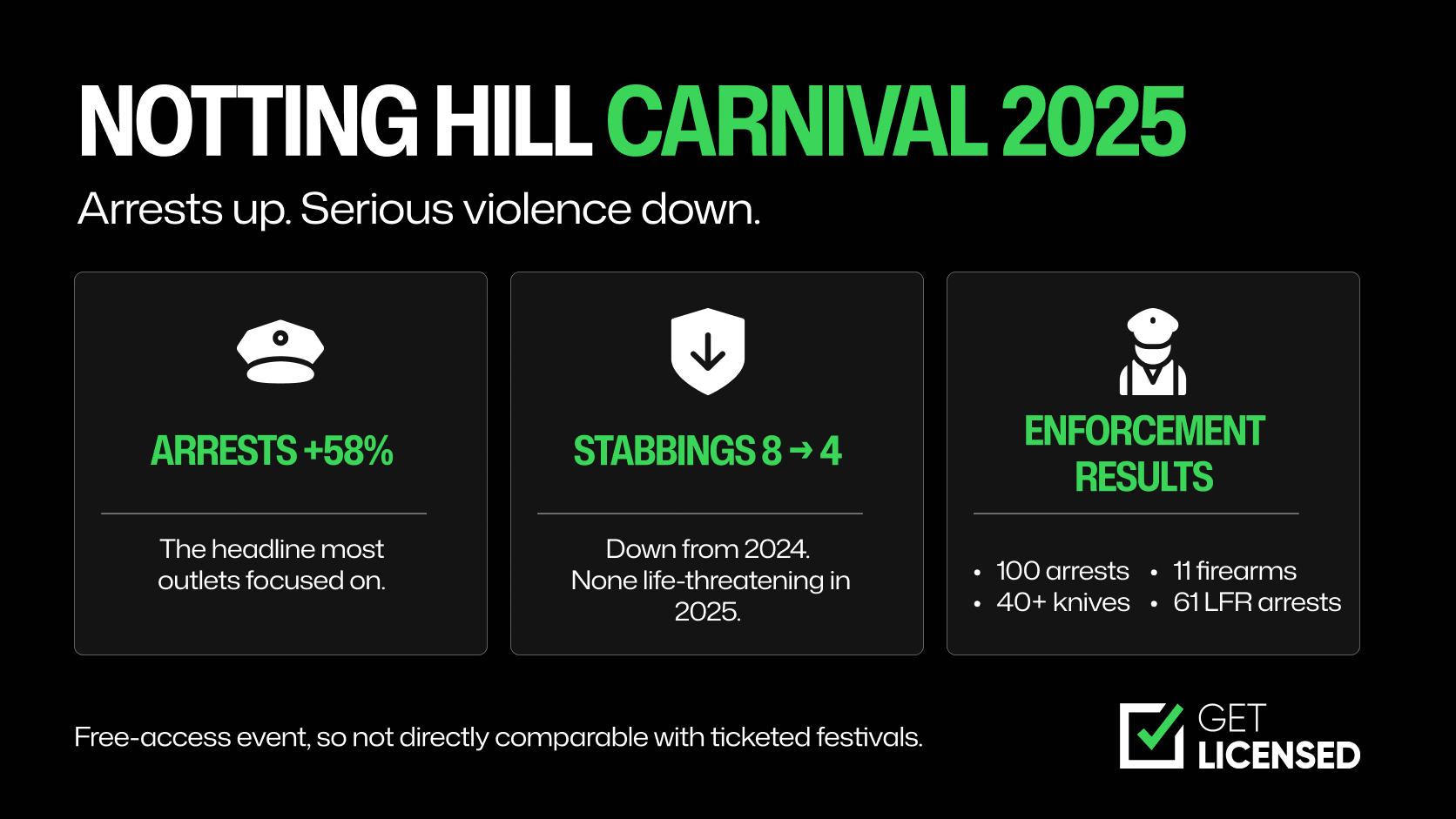
If the 2025 Carnival was covered in only one dimension by most outlets — "arrests up 58%" — the Met Police's own assessment was sharper. Serious violence fell across all published categories:
- Stabbings: 8 in 2024 (one fatal) → 4 in 2025, none life-threatening
- Pre-event operation: 100 arrests, 11 firearms seized, 40+ knives recovered
- 61 on-event arrests followed live facial recognition identifications
Carnival sits outside the ticketed-festival ranking because its scale and free-access format produce a fundamentally different policing operation. But the signal from 2024 to 2025 is the same one visible at Parklife and Boardmasters: when pre-event enforcement is substantial enough to intercept the people most likely to cause serious harm, the harm they would have caused doesn't happen.
The second part of an independent review into Carnival crowd safety was due to report recommendations in late 2025. Whatever the review concludes, the 2025 outcome data gives organisers and the Met a clear evidence base to work from.
Sexual Offences: The Category That Deserves A Separate Lens
Sexual offence arrests rose in 2024 and 2025 at almost every major UK festival. TRNSMT 2025's Sunday charges included sexual assault. Boardmasters 2023 opened a serious sexual assault investigation that continued after the festival.
But arrest data captures only the small tip of the problem. Research into sexual violence at UK music festivals has consistently shown that the majority of incidents are never reported to police, and that reported incidents cluster in predictable environments: poorly-lit camping areas, remote corners of festival sites, and late-night walking routes between stages and campsites.
The operational answers are well established and within the festival organisers' control. Better-distributed site lighting, visible SIA-licensed steward and security presence in camping zones, clearly signposted welfare tents with trained specialist staff, and explicit reporting pathways — verbal, written and via festival apps — all reduce both incidence and under-reporting. The festivals that have invested here consistently perform better; the festivals that haven't, don't.
Summer 2026 Outlook
Two material changes to the 2026 calendar affect what attendees should expect.
Glastonbury is Not Running in 2026
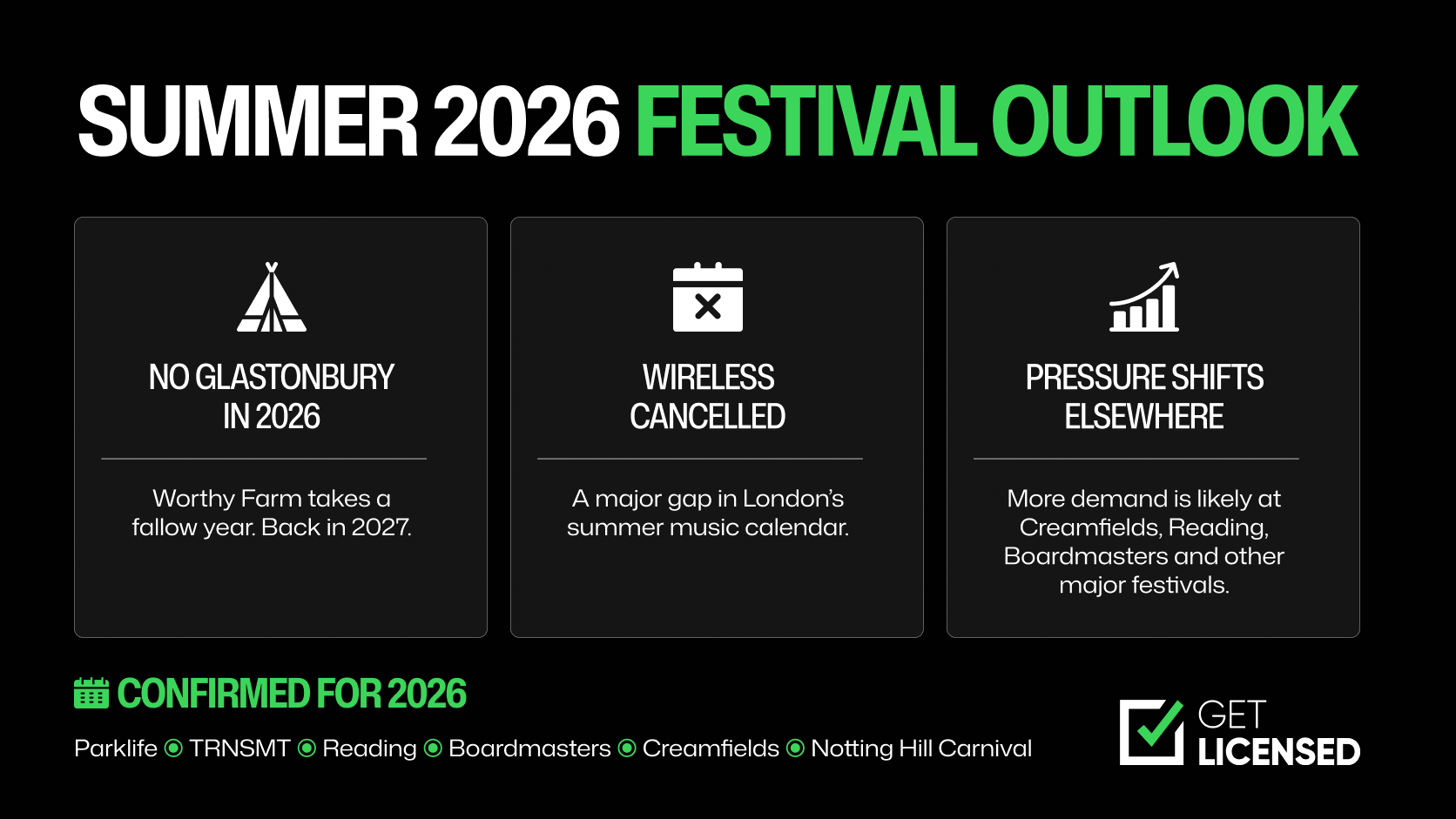
Emily Eavis confirmed during the 2025 festival that Worthy Farm would take a fallow year — a periodic feature of Glastonbury's operating rhythm since 1988 — with the festival due to return in 2027.
Ticket demand that would normally sit with Glastonbury will spread across Creamfields, Reading, Boardmasters and other summer festivals in particular, raising the operational bar for those events.
Wireless Festival Was Cancelled
This development came about after the scheduled headliner's UK entry was denied, and sponsors withdrew. Its absence leaves a gap in the London summer calendar and removes one of the UK's largest rap and hip-hop festivals from the 2026 picture.
Every other major festival covered in this report is confirmed running in 2026: Parklife in June, TRNSMT in July, Reading and Boardmasters in August, Creamfields in August, and Notting Hill Carnival on the August bank holiday.
Based on what the 2025 data shows, the festivals most likely to post strong safety outcomes in 2026 are those already investing at the gate, expanding welfare infrastructure on site, and partnering with The Loop where drug use is a material audience risk.
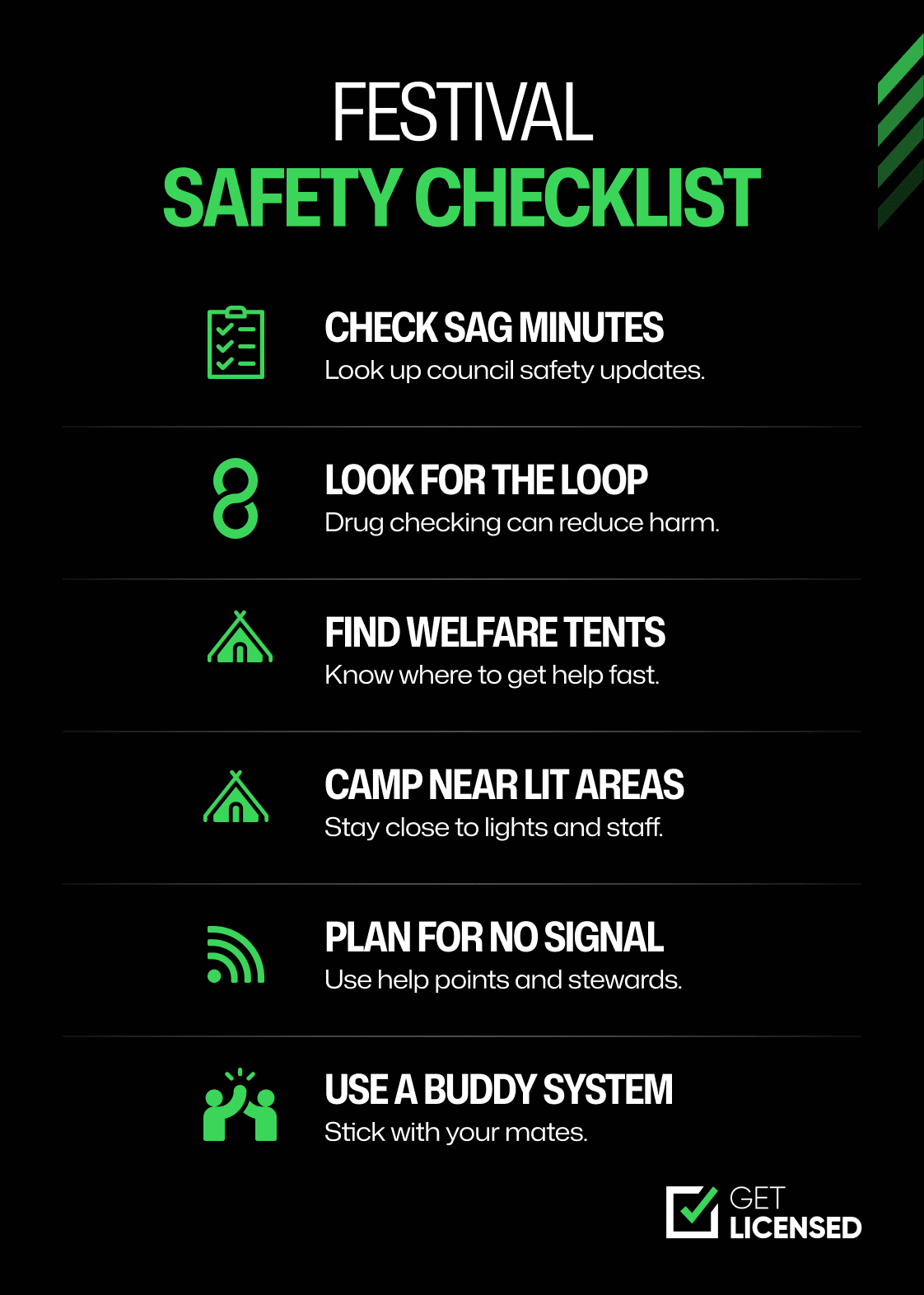
Your Festival Safety Checklist
- Check the local authority's Safety Advisory Group minutes. Most UK festivals operate under a council SAG whose minutes are public, detailing risk assessments and agreed mitigations.
- Look for a published drug-checking partnership. Festivals working with The Loop have measurably lower drug-related harm.
- Find welfare tents before you need them. Welfare staff handle spiking concerns, lost friends, medical needs and mental-health support.
- Camp near lit pathways and staffed zones. Sexual offence reports cluster in poorly-lit, remote areas of campsites.
- Plan for no phone signal. Help points, steward radios and welfare tents all work when the mobile network is overwhelmed.
- Use the buddy system intentionally. Lost-friend incidents account for most welfare-tent visits.
The Blueprint: What Works and Why 2026 Will Test It
The 2024 to 2025 data describes a festival circuit that is quietly professionalising. Arrests fell materially at Parklife, TRNSMT, Boardmasters and Reading Festival; stabbings halved at Notting Hill Carnival; harm at drug-checking festivals continues to run well below festivals without.
None of it happened by accident — each outcome reflects a deliberate operational choice to intercept harm earlier, resource welfare properly, and deploy professional gate-level security more intelligently.
With Glastonbury on a fallow year and Wireless off the 2026 calendar, a compressed, higher-demand summer will test how deep those gains go. Ticket demand will concentrate on fewer events, raising the operational bar for every festival that remains. The events that hold their ground — investing in professional SIA training at scale, welfare infrastructure on site, and harm-reduction partnerships — will set the benchmarks the rest of the industry follows. The ones that don't will face a measurable safety deficit.
The 2025 data is unambiguous: festival safety is no longer a matter of luck or reactive crisis management. It is the direct result of professional operational choices made months before the gates open. For organisers, that is the blueprint. For attendees, it is the checklist. For the security workforce that executes it, it is the evidence base that validates their profession.
Methodology
This report compiles publicly available post-event arrest and crime data from seven UK police forces responsible for Britain's major summer music festivals, covering the 2024 and 2025 festival seasons.
Data Sources
For each festival, we pulled the responsible regional police force's post-event summary — Greater Manchester Police for Parklife, Police Scotland for TRNSMT, Devon & Cornwall Police for Boardmasters, Thames Valley Police for Reading Festival, Cheshire Police for Creamfields, Avon and Somerset Police for Glastonbury, and the Metropolitan Police for Notting Hill Carnival.
Timeframe
We restricted the main ranking to festivals with verified single-year data from both 2024 and 2025 to ensure a valid year-on-year comparison. All six ticketed festivals covered in this report (Parklife, TRNSMT, Boardmasters, Reading Festival, Creamfields, and Glastonbury) have complete year-on-year data for both 2024 and 2025. Notting Hill Carnival is included as a standalone comparison point due to its distinct free-access format and scale.
Operational Context Layer
Arrest numbers alone describe enforcement outcomes rather than the full safety picture. To provide the wider lens, we drew on published harm-reduction research from The Loop (via Transform Drug Policy Foundation), academic research on festival drug-related deaths 2017–2023 (Cooney & Measham, University of Liverpool), published medical-load research from Glastonbury 2022, the 2025 Sage-published survey of UK festival attendees (Rayner et al.), and documented sexual-violence research from the British Academy and Durham University.
Capacity and Attendance
Each festival's publicly stated capacity is used for context. Capacity is not identical to attendance — some festivals do not sell out — but it provides a consistent denominator.
Reporting Differences
Police forces report post-event data in slightly different formats: some publish cumulative weekend totals, some break down by day. TRNSMT's figures sit within Scotland's separate legal framework; the year-on-year comparison reported here is within-festival and unaffected by that difference, but cross-festival comparisons between TRNSMT and English ticketed festivals should be read with that context in mind.
References
Festival Arrests & Crime Data
Herald Scotland — TRNSMT 2024 | Cornwall Live — Boardmasters 2025 | GMP — Parklife 2024 | Thames Valley Police — Reading 2025 | Met Police — Notting Hill Carnival 2025 | Somerset Live — Glastonbury 2025 | GMP appeal — Parklife 2024 | Bury Times — Parklife 2025 | Glasgow Times — TRNSMT 2025 | NME — Boardmasters 2024 | Reading Chronicle — Reading 2024 | Somerset County Gazette — Glastonbury 2024 | Somerset County Gazette — Glastonbury 2025 | Liverpool Echo — Creamfields 2025 | BBC — Creamfields 2024
Drug-Checking & Harm Reduction
The Guardian — drug testing at festivals | The Loop — drug testing | The Loop — history | DJ Mag — drug checking
Academic Research
Cooney & Measham — Drug deaths 2017–2023 | PMC — Glastonbury medical care | Rayner et al. — Substance use patterns | British Academy — Sexual violence research | Durham University — Festival safety analysis
Festival Calendar & Policy
BBC News — Glastonbury 2026 fallow year | BBC News — Wireless cancellation | Glastonbury — Official announcement
Incident & Safety Reviews
NME — Boomtown review | Complete Music Update — Boomtown coroner | National World — Boardmasters assault


Find work, try mock tests and book courses from
the UK’s #1 app for security professionals







Get Licensed helps you get SIA trained, licensed, and ready for real security jobs — trusted by 450,000+ people across the UK.


